
Toy Blister Packaging with Header Card.
Final price depends on size, material, finish and quantity. Your packaging manager confirms it before production.
Your custom box, quoted.
The full specification book.
Six chapters. Six colours. Click a tab to turn the page.
Toy Blister Packaging with Header Card
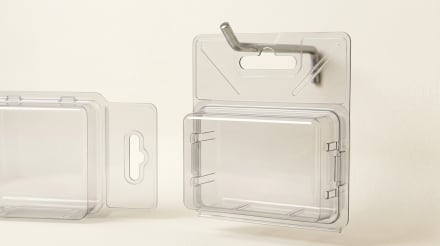
The header card is the shelf presence here, die-cut, printed and hung where children will see it.
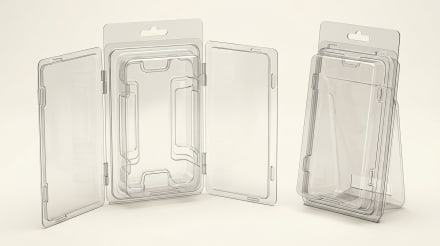
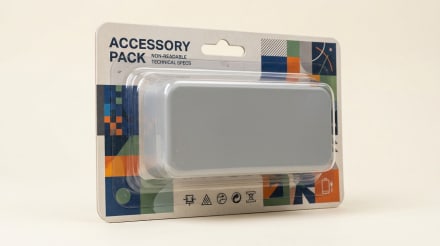
The toy shows through a formed shell while the card above carries the character, the age grading and the peg hole that holds it all up.

Every detail. Intentional.
The header carries the sale
The blister only reveals.
Age grading is required
Print space planned in.
Peg hole under real load
Reinforced against tear-out.
Child-height typography
Read from below, not above.
Try-me apertures
Where the toy demonstrates itself.
Licensed art approvals
Built into the schedule.
Built like architecture.
Every order of Toy Blister Packaging with Header Card is an engineered build, measured, dieline-cut and hand-wrapped to spec. Below is the standard build sheet.
✦ Need a custom spec? Talk to our atelier. Every detail is negotiable.
Every surface, hand-selected.
What this product is built from, and the surfaces it takes. Below the build sheet sits the full swatch library. Every option applies across our range, and a physical swatch set is available on request.
Material
The board and paper your box is built from.
 ◷ FINISH
 ◷ FINISH
 ◷ FINISH
 ◷ FINISH
 ◷ FINISH
 ◷ FINISH
 ◷ FINISH
 ◷ FINISH
 ◷ FINISH
Finishes
How the outer surface looks, feels, and catches light.
 ◷ FINISH
 ◷ FINISH
 ◷ FINISH
 ◷ FINISH
 ◷ FINISH
 ◷ FINISH
 ◷ FINISH
 ◷ FINISH
 ◷ FINISH
 ◷ FINISH
 ◷ FINISH
 ◷ FINISH
Add-ons
Closures, linings, and hardware that complete the build.
 ◷ FINISH
 ◷ FINISH
 ◷ FINISH
 ◷ FINISH
 ◷ FINISH
 ◷ FINISH
 ◷ FINISH
 ◷ FINISH
 ◷ FINISH
 ◷ FINISH
 ◷ FINISH
 ◷ FINISH
 ◷ FINISH
 ◷ FINISH
 ◷ FINISH
 ◷ FINISH
 ◷ FINISH
✦ Mix and match across all three and we'll build your exact combination.
The full kit of capabilities.
Sizing & dieline.
We cut Toy Blister Packaging with Header Card to a dieline built around your product instead of pulling a stock size off the shelf. Send us the length, width and height of the item (or the item itself) and we return a measured dieline, free, before you commit to anything.
Length, width and height of the item itself, at its widest points. Measure the product, not the box you happen to use today.
Allow 2–4 mm on each axis for a snug fit, and more if you are adding foam, a pillow insert or tissue.
We quote as Length × Width × Height. Tell us whether you are working in millimetres or inches and we match it.
✦ Not sure of your size? Send us the product and we measure it and build the dieline.
Pricing & minimums.
We price Toy Blister Packaging with Header Card per specification rather than from a fixed list, because the same build in two different finishes can land at very different numbers. Below is what actually moves the price, so you can shape the spec before you request a quote.
The single biggest lever. Unit cost falls sharply as volume rises, because setup and tooling spread across more pieces.
Board weight and stock choice change both the raw material cost and the shipping weight of the finished run.
Foil, spot UV, embossing and soft-touch each add a pass on press. One or two lift the box; five compound the cost.
Full-bleed print inside and out costs more than a one-sided design on natural stock.
Foam, moulded pulp, velvet pillows, magnets and ribbon are priced per piece on top of the box itself.
Standard production is the base rate. Rush moves you up the production queue and carries a surcharge.
✦ Quotes returned within 24 hours.
Questions, answered.
Everything you need to know about Toy Blister Packaging with Header Card.
Toy header cards are usually printed on 14 to 18 pt board with a heat-seal coating on the face. The coating is what bonds the formed blister flange to the card under heat and pressure. Heavier toys go toward the 18 pt end so the card and peg hole don't bend on the wall.
Thinner cards are fine for light figures and small accessories.
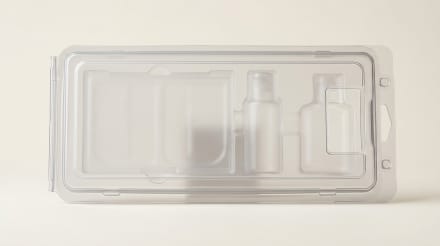
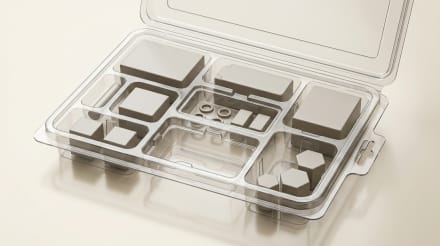
Yes, we tool accessory wells into the same blister so each piece sits in its own pocket beside the main figure. The cavity is formed true to the toy, which keeps parts from sliding and scratching one another in transit. Collectors expect a composed layout with every accessory in view.
Send final production samples of every piece so the wells fit tightly.
Yes, collector packs are designed to stay sealed and still look sharp years later. That means clean card corners, a coating that resists scuffing and a PET blister that won't yellow the way older PVC can. Retail packs meant to be opened can use a simpler card with a strong seal.
Tell us early if the line will be graded, because corner shape and coating are settled at the dieline stage.
Toy cards usually get full CMYK in saturated colour, and spot UV can pick out the character or logo. Foil is kept for chase variants so a rare version is easy to spot on the peg. Size the key message for a child's eye level, which sits below the header rather than above it.
Leave a clear area on the card for the age grading marks and any licensor approval stamp.
Toy header cards commonly run from 6 × 9 in to 10 × 14 in, measured flat. Pick the size from the toy plus a card margin for the seal, then check it against the peg spacing at your retailers. The header above the blister needs enough height for the character art and the hang hole.
We reinforce the peg area on larger cards so heavy toys don't tear out.
We would go with PET or RPET for new toy lines, and keep PVC for legacy tools that already run it. PET is clear, forms cleanly around detailed shapes and is easier to place in recycling streams. PVC forms well at a lower cost, but some retailers now ask brands to move away from it.
The heat-seal coating on the card is matched to whichever sheet you choose.
The floor for toy blister cards is 500 units. Collector lines and chase variants often run small, and that floor lets you test a character before committing to a full wave of up to 100,000.
Build licensed art approvals into the schedule before we book the run, since they're usually the slowest step.
Once you and your licensor approve the art, production takes 7 to 10 business days. A rush run takes 5 to 7. Sealed samples on printed cards take 5 to 7 business days, and they're often what the licensor signs off. The sample fee is taken off your production bill.
Other products you might love.
Ready to start your Toy Blister Packaging with Header Card project?
Get a free quote in 24 hours. Our atelier is here to help.