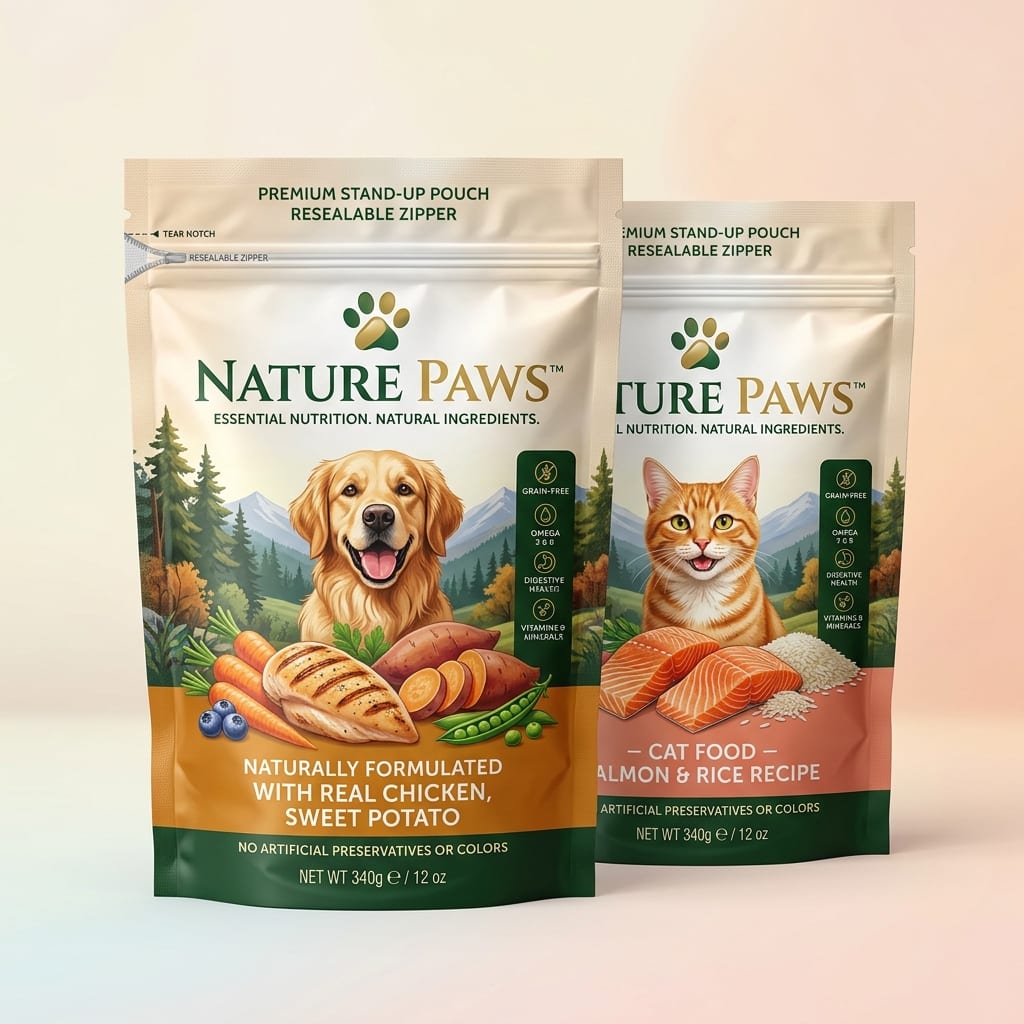
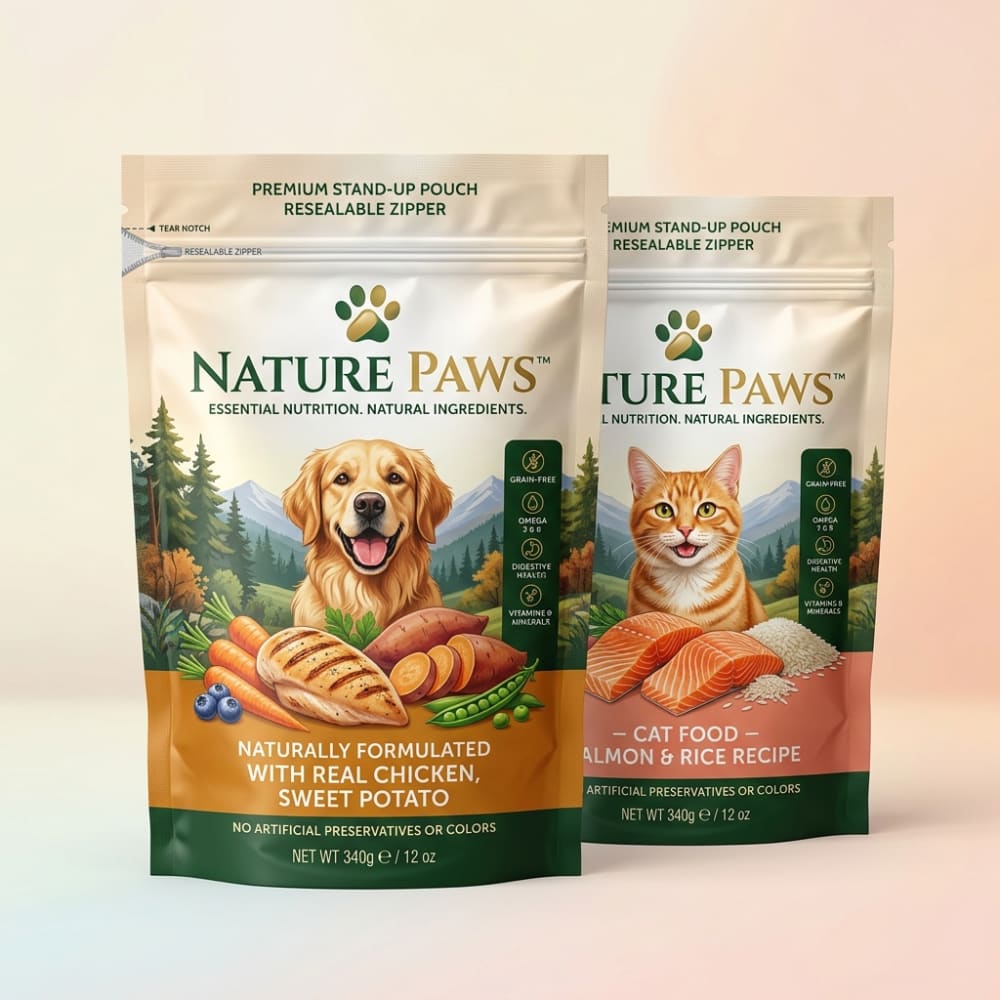
Pet Food Packaging.
Final price depends on size, material, finish and quantity. Your packaging manager confirms it before production.
Your custom box, quoted.
The full specification book.
Six chapters. Six colours. Click a tab to turn the page.
Pet Food Packaging
Bulk weight in a flexible pack, plus fat that attacks the wrong laminate from the inside.
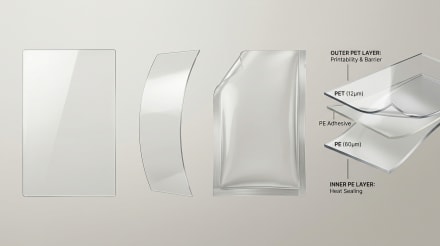
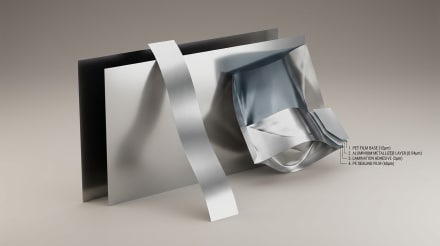
Five to fifteen pound formats need gauge and seal width matched to a bag that gets lifted, dragged and stored open. Oily kibble migrates into unsuitable films, so the inner layer follows the formulation.
Every detail. Intentional.
Gauge against filled weight
The bag is lifted repeatedly, not once.
Fat attacks cheap film
The inner layer is chosen for the recipe.
Handles for carrying
Punched or applied on larger formats.
Reseal for storage
Bags stay open for weeks after the first use.
Smell kept in the bag
Pets find a leaking pack before owners do.
Scuff-resistant laminate
Large bags are dragged and stacked.
Built like architecture.
Every order of Pet Food Packaging is an engineered build, measured, dieline-cut and hand-wrapped to spec. Below is the standard build sheet.
✦ Need a custom spec? Talk to our atelier. Every detail is negotiable.
Every surface, hand-selected.
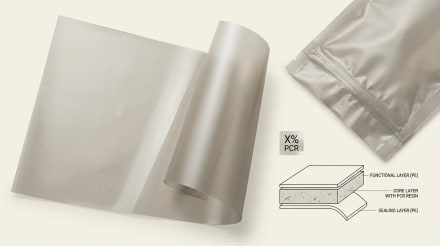
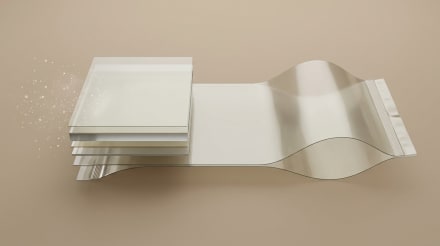
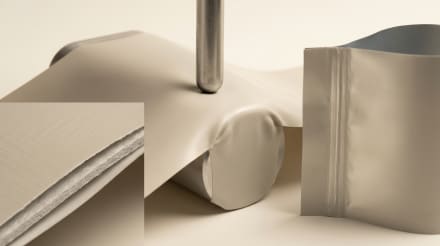
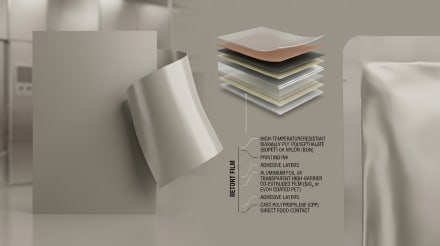
What this product is built from, and the surfaces it takes. Below the build sheet sits the full swatch library. Every option applies across our range, and a physical swatch set is available on request.
Material
The board and paper your box is built from.
 ◷ FINISH
 ◷ FINISH
 ◷ FINISH
 ◷ FINISH
 ◷ FINISH
 ◷ FINISH
 ◷ FINISH
 ◷ FINISH
 ◷ FINISH
 ◷ FINISH
 ◷ FINISH
 ◷ FINISH
Finishes
How the outer surface looks, feels, and catches light.
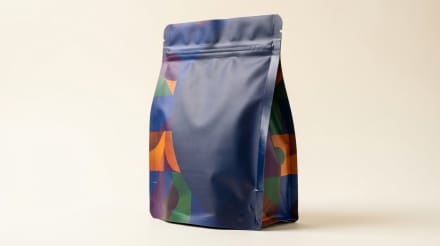 ◷ FINISH
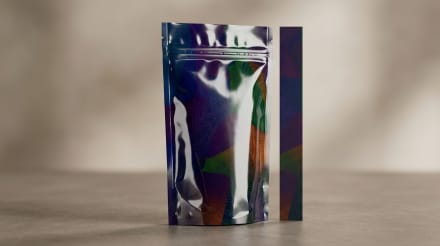 ◷ FINISH
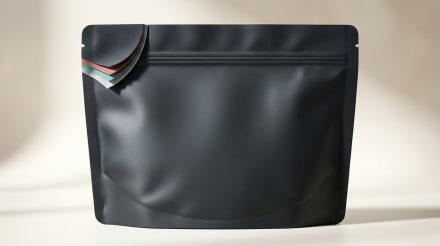 ◷ FINISH
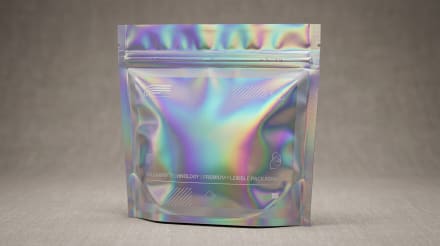 ◷ FINISH
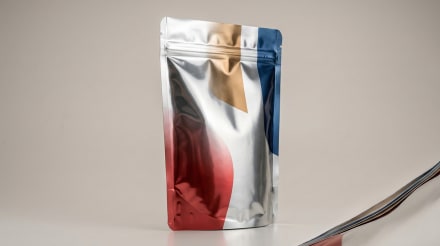 ◷ FINISH
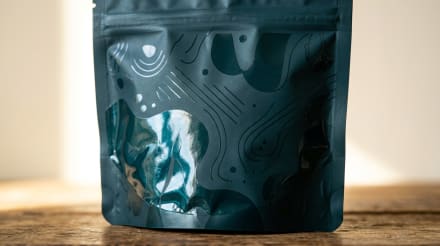 ◷ FINISH
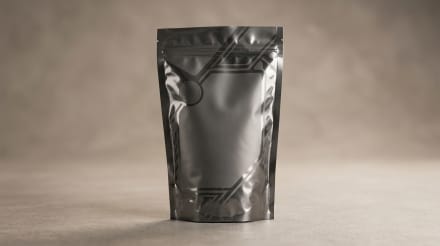 ◷ FINISH
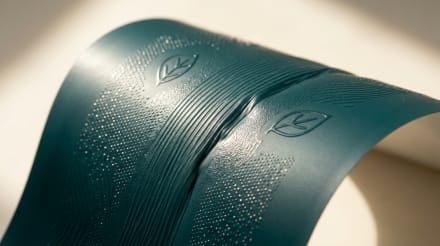 ◷ FINISH
 ◷ FINISH
 ◷ FINISH
 ◷ FINISH
 ◷ FINISH
Add-ons
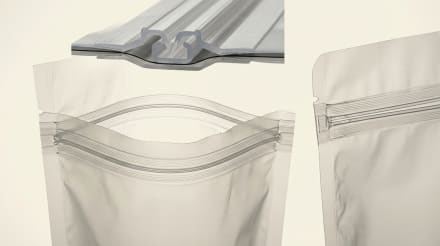
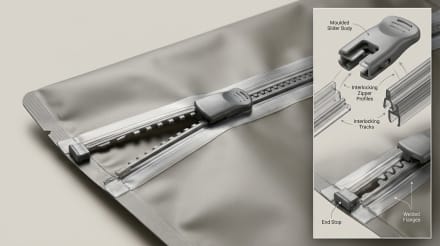
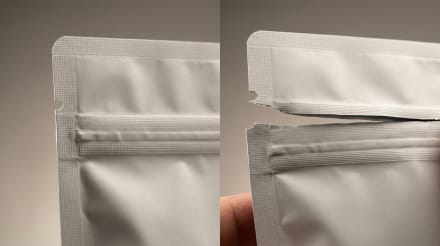
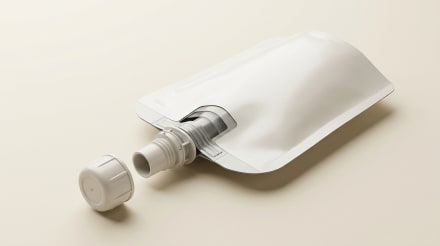
Closures, linings, and hardware that complete the build.
 ◷ FINISH
 ◷ FINISH
 ◷ FINISH
 ◷ FINISH
 ◷ FINISH
 ◷ FINISH
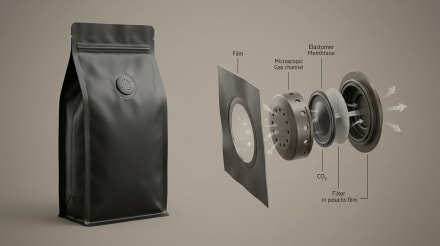 ◷ FINISH
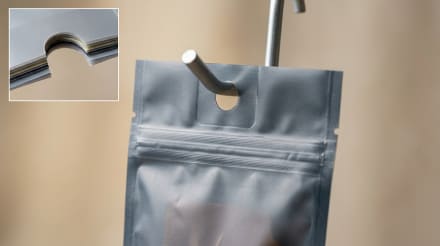 ◷ FINISH
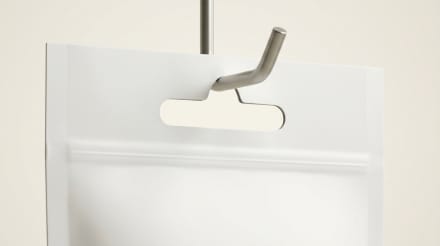 ◷ FINISH
 ◷ FINISH
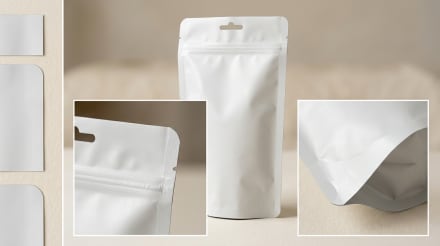 ◷ FINISH
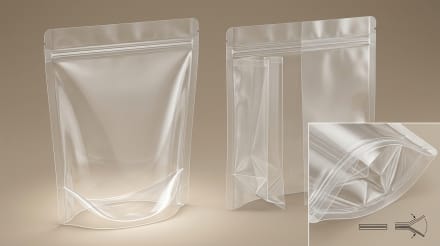 ◷ FINISH
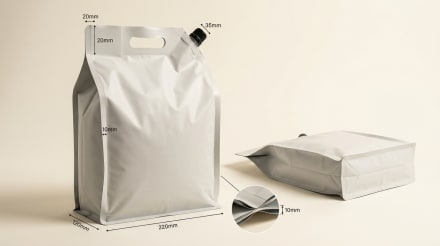 ◷ FINISH
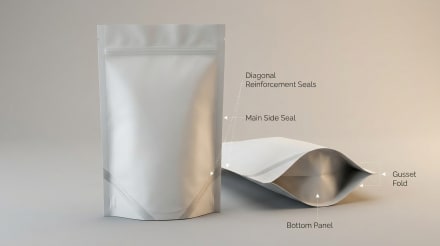 ◷ FINISH
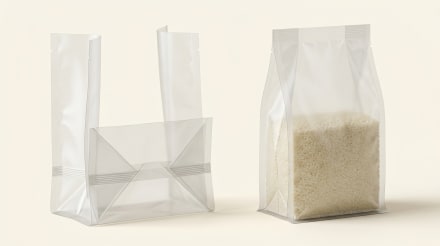 ◷ FINISH
 ◷ FINISH
✦ Mix and match across all three and we'll build your exact combination.
The full kit of capabilities.
Sizing & dieline.
Every Pet Food Packaging is made to your fill, not pulled off a shelf. A pouch is quoted width × length, plus the gusset that lets it stand. Tell us what goes inside and how much of it, and we return a measured spec, free, before you commit to anything.
A pouch is sized by what goes in it, not by outside dimensions. Give us the fill weight and, if you can, the bulk, since 500 g of granola needs far more bag than 500 g of powder.
We quote width × length, then the bottom gusset depth that sets the footprint. Three figures, and the gusset is the one most often left off.
Zipper or heat seal only, valve or no valve, window or full barrier. These change the film and the bag height, so they belong in the spec rather than added afterwards.
✦ Not sure of your size? Send us the product and we measure it and build the dieline.
Pricing & minimums.
We price Pet Food Packaging per specification rather than from a fixed list, because the same build in two different finishes can land at very different numbers. Below is what actually moves the price, so you can shape the spec before you request a quote.
The single biggest lever. Unit cost falls sharply as volume rises, because setup and tooling spread across more pieces.
Board weight and stock choice change both the raw material cost and the shipping weight of the finished run.
Foil, spot UV, embossing and soft-touch each add a pass on press. One or two lift the box; five compound the cost.
Full-bleed print inside and out costs more than a one-sided design on natural stock.
Foam, moulded pulp, velvet pillows, magnets and ribbon are priced per piece on top of the box itself.
Standard production is the base rate. Rush moves you up the production queue and carries a surcharge.
✦ Quotes returned within 24 hours.
Questions, answered.
Everything you need to know about Pet Food Packaging.
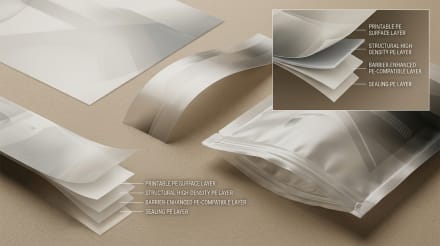
Fat from kibble migrates into an unsuitable inner film, softens it and weakens the seals from the inside. The bag looks fine at packing and fails on the shelf weeks later. On higher-fat recipes we specify a grease-resistant sealant layer that the oil cannot penetrate.
This is the one spec we insist on knowing before we quote. Send us the fat percentage on the label and we'll match the inner layer to it, since a standard laminate that is fine for a dry biscuit is the wrong bag for an oily one.
Up to about 1 kg a stand-up pouch works, from 1 to 5 kg we move to quad seal or flat bottom, and above 5 kg a flat bottom or side gusset bag with a handle. A stand-up pouch bulges under weight and will not stand once it passes roughly 2 kg, so we do not offer it there.
Vertical corner seals on a quad seal bag act as posts that hold a heavy fill square. That matters for a bag that is dragged across a floor and stacked on a pallet.
Above 5 kg we punch a reinforced die-cut handle into the top seal, or apply a separate plastic handle for the largest formats. The die-cut version gets an extra patch of material at the hole so it does not tear out on the first lift.
Handle tear-out is a packaging failure we see whenever someone skips the reinforcement to save a cent. A 15 lb bag is lifted from the car, into the cupboard and out again every feeding time, so the hole has to survive dozens of lifts rather than one.
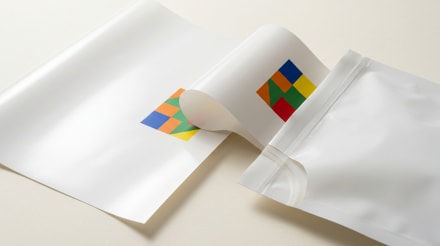
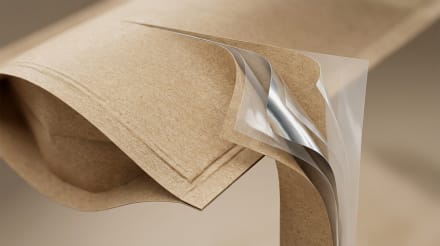
Matte lamination is the premium look in pet and it hides the scuffs a heavy bag picks up, which is why most of our pet customers choose it. Gloss gives saturated colour for grocery and mass retail. A kraft outer suits natural and grain-free ranges.
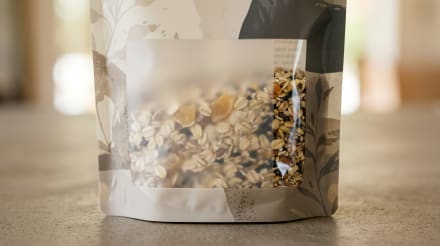
Gravure print covers the large faces edge to edge, with room for a feeding guide panel on the back or side. A clear window showing kibble size is a purchase factor shoppers really use. Soft-touch is there for premium and veterinary lines.
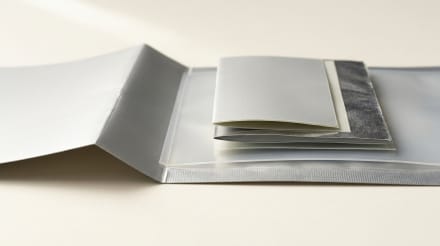
Sizing starts from the filled weight and the bulk density of the kibble, not from a flat dimension. A 9 x 14 inch side gusset bag covers 5 lb for most dry foods, and a 12 x 18 inch bag handles 15 lb. Gusset depth is added to those figures.
Send us a cup of your food and the target weight. Density varies enough between a small biscuit and a large freeze-dried piece that the same bag can be right for one and half-empty for the other.
A custom pet food bag runs from 500 pieces per size and design. Large-format gusseted bags carry more film than a small pouch, so the per-unit cost is higher, and it steps down as the quantity passes 1,000. We can take a single design across several sizes on one order.
The top of the range is 100,000 bags. Most of the brands we pack for start at the minimum on a new recipe and reorder in the thousands once it sells.
Standard turnaround is 7 to 10 business days after approval, with a 5 to 7 business day rush available. Samples are 5 to 7 business days, and we knock the sample cost off the production invoice when you order.
Fill a sample to weight, lift it by the handle a few dozen times and leave it open for a week. That covers the three ways a pet food bag fails in the wild, and it is cheaper than finding out from a customer.
Film gauge of 0.14 to 0.20 mm gives the laminate enough body to take abrasion from kibble on the inside and scuffing on the outside. Kibble is abrasive, and a thin film wears through at the base after a few weeks of being slid in and out of a cupboard.
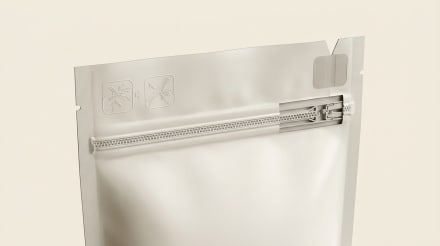
The zipper or slider closure keeps the bag closed between feeds, which keeps smell in and moisture out. A slider is the easier of the two to work one-handed on a large, heavy bag.
Other products you might love.
Ready to start your Pet Food Packaging project?
Get a free quote in 24 hours. Our atelier is here to help.