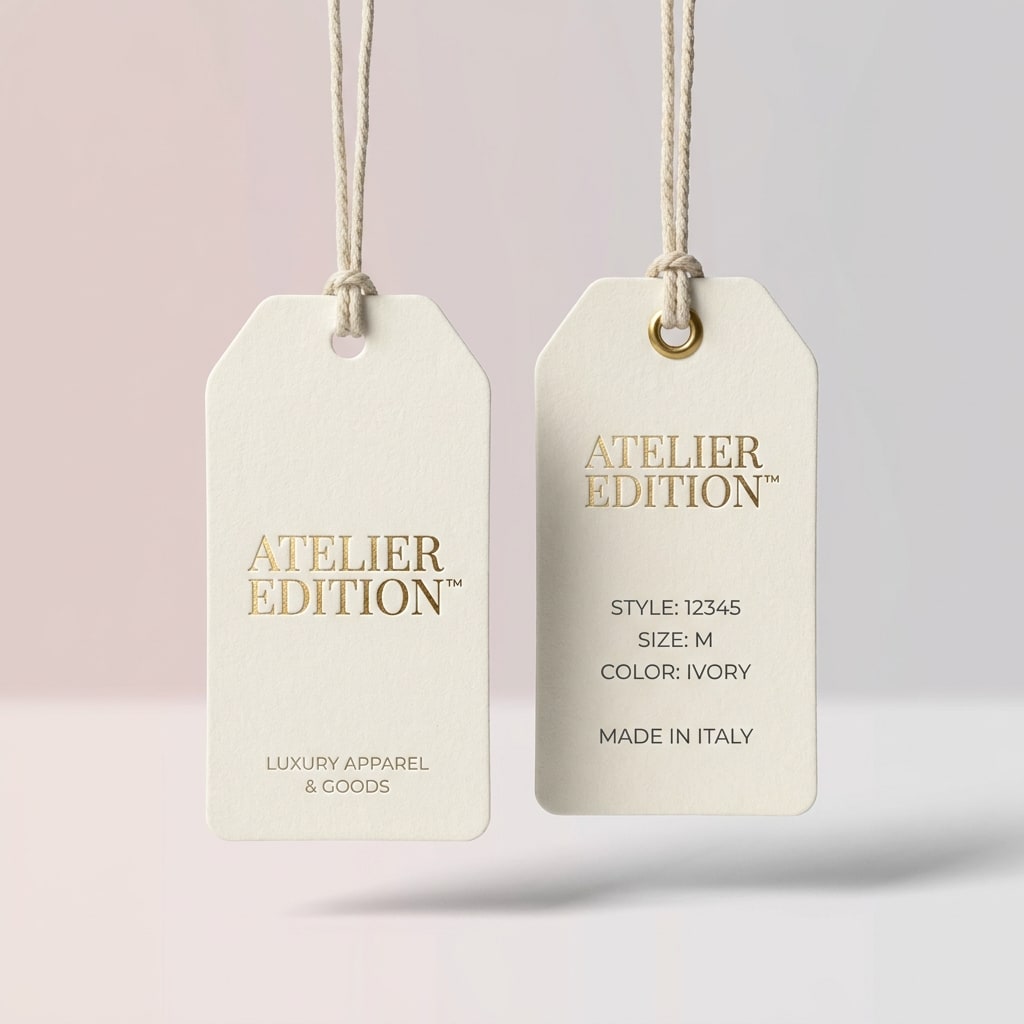
Hanging Tags.
Final price depends on size, material, finish and quantity. Your packaging manager confirms it before production.
Your custom box, quoted.
The full specification book.
Six chapters. Six colours. Click a tab to turn the page.
Hanging Tags
Held between finger and thumb, which makes stock weight disproportionately legible.
The last piece of communication before purchase, and in apparel a real part of how a garment is judged. Thin coated card reads disposable; uncoated 350gsm reads considered.

Every detail. Intentional.
Weight is felt immediately
300–400gsm is the working range.
Thin card reads disposable
Uncoated stock reads considered.
Metal eyelets signal quality
And prevent tear-through at the hole.
The attachment is design
String, ribbon, twine or barb.
Barcodes need clear ground
Away from folds, foil and dark fields.
Letterpress on heavy stock
The premium tier's signature.

Built like architecture.
Every order of Hanging Tags is an engineered build, measured, dieline-cut and hand-wrapped to spec. Below is the standard build sheet.
✦ Need a custom spec? Talk to our atelier. Every detail is negotiable.
Every surface, hand-selected.
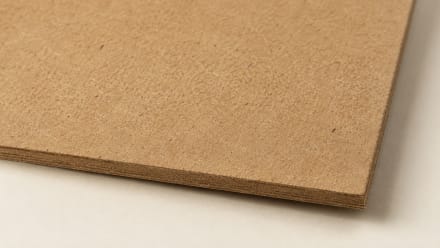
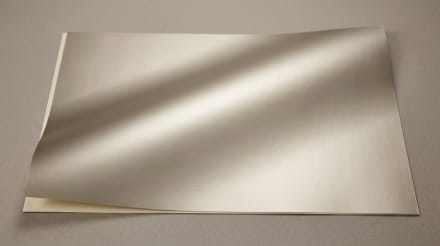
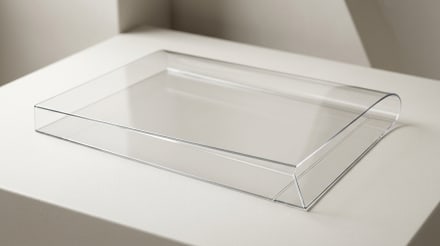
What this product is built from, and the surfaces it takes. Below the build sheet sits the full swatch library. Every option applies across our range, and a physical swatch set is available on request.
Material
The board and paper your box is built from.
 ◷ FINISH
 ◷ FINISH
 ◷ FINISH
 ◷ FINISH
 ◷ FINISH
Finishes
How the outer surface looks, feels, and catches light.
 ◷ FINISH
 ◷ FINISH
 ◷ FINISH
 ◷ FINISH
 ◷ FINISH
 ◷ FINISH
 ◷ FINISH
 ◷ FINISH
 ◷ FINISH
 ◷ FINISH
 ◷ FINISH
 ◷ FINISH
 ◷ FINISH
 ◷ FINISH
 ◷ FINISH
 ◷ FINISH
 ◷ FINISH
 ◷ FINISH
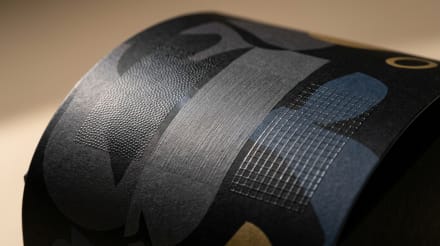 ◷ FINISH
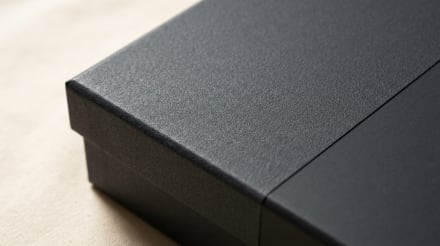 ◷ FINISH
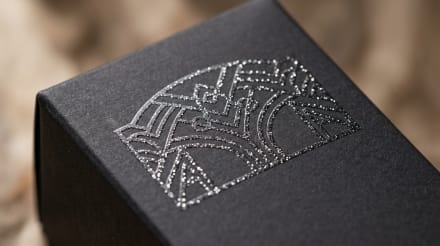 ◷ FINISH
 ◷ FINISH
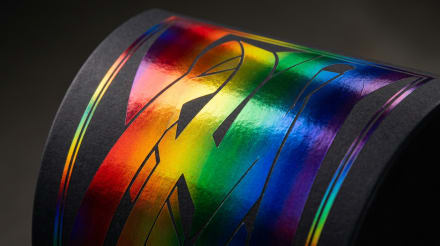 ◷ FINISH
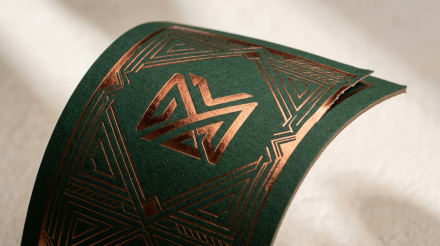 ◷ FINISH
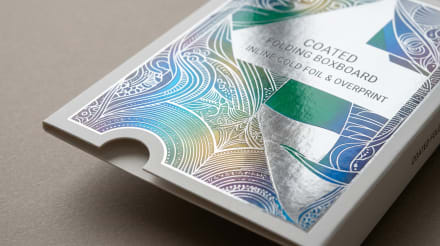 ◷ FINISH
 ◷ FINISH
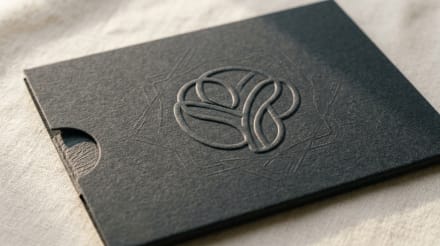 ◷ FINISH
 ◷ FINISH
 ◷ FINISH
 ◷ FINISH
 ◷ FINISH
Add-ons
Closures, linings, and hardware that complete the build.
 ◷ FINISH
✦ Mix and match across all three and we'll build your exact combination.
The full kit of capabilities.
Sizing & dieline.
We cut Hanging Tags to a dieline built around your product instead of pulling a stock size off the shelf. Send us the length, width and height of the item (or the item itself) and we return a measured dieline, free, before you commit to anything.
Length, width and height of the item itself, at its widest points. Measure the product, not the box you happen to use today.
Allow 2–4 mm on each axis for a snug fit, and more if you are adding foam, a pillow insert or tissue.
We quote as Length × Width × Height. Tell us whether you are working in millimetres or inches and we match it.
✦ Not sure of your size? Send us the product and we measure it and build the dieline.
Pricing & minimums.
We price Hanging Tags per specification rather than from a fixed list, because the same build in two different finishes can land at very different numbers. Below is what actually moves the price, so you can shape the spec before you request a quote.
The single biggest lever. Unit cost falls sharply as volume rises, because setup and tooling spread across more pieces.
Board weight and stock choice change both the raw material cost and the shipping weight of the finished run.
Foil, spot UV, embossing and soft-touch each add a pass on press. One or two lift the box; five compound the cost.
Full-bleed print inside and out costs more than a one-sided design on natural stock.
Foam, moulded pulp, velvet pillows, magnets and ribbon are priced per piece on top of the box itself.
Standard production is the base rate. Rush moves you up the production queue and carries a surcharge.
✦ Quotes returned within 24 hours.
Questions, answered.
Everything you need to know about Hanging Tags.
Most hang tags sit between 300 and 400gsm, and 350gsm uncoated card is where we'd start. The tag is held between finger and thumb, so weight is felt before anything is read. Thin coated card comes across as disposable, while heavier uncoated stock feels considered.
Mass-market lines can sit at the lighter end. Boutique and luxury labels usually go to 400gsm, or onto cotton and textured papers.
Match the attachment to the price point, because shoppers read string, ribbon, twine and plastic barbs as clearly as they read the print. Cotton string suits premium and sustainable lines, and a nylon barb is the secure choice for mass retail. Ribbon belongs with gift and luxury presentation.
A metal eyelet at the hole stops tear-through, which is the most common way a tag fails on the rail. It also signals quality before the tag is turned over.
Letterpress on heavy uncoated stock is the signature premium finish, because the impression sinks into the soft card. Hot foil on a matte tag carries a small brand mark well. Spot UV adds selective shine over matte lamination, and embossing gives texture without any ink.
Edge painting colours the card edges and shows off a thick stock. We print CMYK and Pantone, and our free design help can lay out the front and back.
Put the barcode on a clear, light ground, well away from folds, foil and dark fields. Scanners struggle when bars cross a crease or sit on a metallic or deep-coloured area. The back of the tag usually carries the working information of barcode, size, price and origin, which leaves the front free for the brand.
Care instructions normally live on the sewn label rather than the tag, so they don't need to compete for this space.
Common sizes are 2 × 3.5 in and 1.5 × 3 in, and custom die shapes can go well beyond the rectangle. Measure the finished tag flat, then decide where the hole sits, since it takes up room at the top. A folded tag is drawn at its open size.
We'd scale the tag to the garment. A small tag on a heavy coat looks lost, and an oversized one on a silk scarf gets in the way.
Yes, recycled stocks and natural kraft board both work, and recyclable board is available. Kraft reads natural and crafted the moment it's picked up. With recycled stock we'd print the claim on the tag, so the shopper knows why the card looks the way it does.
Cotton string on a kraft tag keeps the whole piece free of plastic, which suits a brand making a sustainability case.
Hang tags begin at a 500-tag minimum per design. That covers a season for many small labels, and orders can run to 100,000. If you carry lots of styles, a shared tag with a blank area for a price and size sticker lets one run serve the whole range.
Printing on both sides is part of the same tag, so a two-sided design still counts as one item.
Tags ship 7 to 10 business days after the artwork is approved. A rush turn of 5 to 7 business days is available for a delivery date that can't move. Printed samples take 5 to 7 business days, which gives you a chance to feel the card weight in hand before you commit.
The sample fee is taken off the production invoice.
Other products you might love.




Ready to start your Hanging Tags project?
Get a free quote in 24 hours. Our atelier is here to help.